

The Evolution of Educational Practices
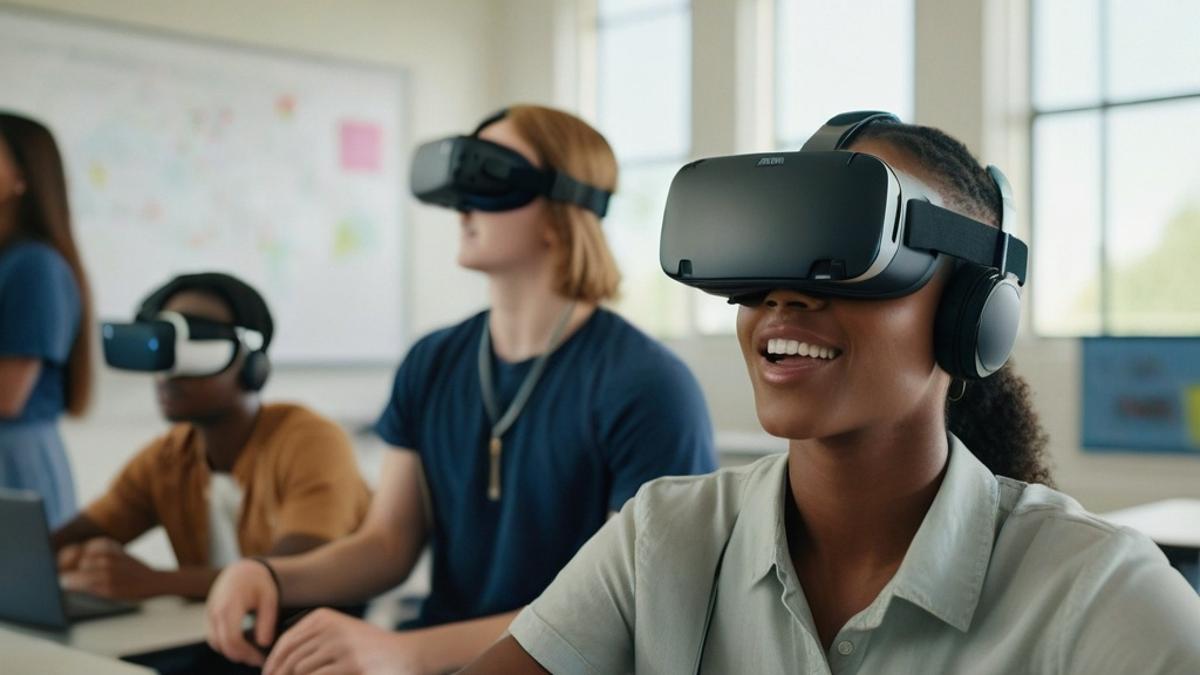
Imagine stepping into a world where high school students in Ohio can dissect virtual frogs without the need for a scalpel, or engineering majors in California can navigate a three-dimensional model of a bridge before it is physically constructed. This futuristic approach is not merely a vision of what’s to come; it is a reality that is already unfolding. Virtual Reality in STEM Education is increasingly transforming how American students comprehend and engage with intricate concepts across various scientific and mathematical domains.
Traditional educational tools such as textbooks and static diagrams often struggle to effectively convey abstract ideas like molecular structures or planetary orbits. Consequently, educational institutions across the United States are investing in immersive learning experiences as a way to enrich students’ understanding and bridge this educational gap. For instance, a virtual chemistry lab allows students to conduct experiments like titration without the risk of dangerous chemical spills, making learning both safe and effective.
Why This Shift Matters Now
The statistics surrounding the adoption of these technologies highlight a significant trend in education. A recent report reveals that over 60% of U.S. school districts have incorporated some form of VR learning in education within the past three years. This shift is not merely a fad; it is driven by tangible advantages such as:
- Increased student engagement and retention rates: Research indicates that students who engage in VR experiences tend to retain information significantly better than their peers who rely on traditional learning methods.
- Safer environments for high-risk experiments: Virtual labs enable students to conduct experiments that may otherwise be hazardous, thus cultivating a hands-on approach to learning without the associated risks.
- Cost-effective alternatives to physical lab equipment: Implementing VR reduces the need for costly lab setups and materials, allowing schools to allocate funds elsewhere.
- Accessibility for students with mobility or sensory challenges: VR can create adaptive environments that are more inclusive for learners with disabilities, broadening participation in STEM fields.
These benefits are not just theoretical; districts from Texas to New York report notable upswings in test scores and overall comprehension after integrating STEM education technology into their curricula. For example, Virginia Beach City Public Schools found that students who utilized VR modules in their science classes outperformed their classmates in traditional classrooms.
What This Article Will Explore
This piece aims to delve into the practical applications of VR technology that are reshaping American classrooms today. We will highlight virtual reality teaching tools already in active use, ranging from detailed chemistry simulations to expansive astronomy modules that allow students to explore the universe in astonishing detail.
In addition to examining these innovative tools, we will unpack the tangible benefits of VR in education, supported by comprehensive classroom data and insights from educators who have witnessed firsthand the positive impact of this technology. The central question is no longer whether VR belongs in STEM education—it’s instead about how far this innovative technology can go and how it can redefine the learning landscape for future generations.
YOU MAY ALSO LIKE: The Impact of Open Educational Resources (OER) on Student Engagement and Learning Outcomes
# Inside the Virtual Classroom: Tools Transforming STEM LearningWalk into a modern science classroom in Austin, Texas, or a robotics lab in suburban Chicago, and you might notice something unusual: students wearing headsets, gesturing at thin air, and reacting to things no one else in the room can see. This is the new face of Virtual Reality in STEM Education, and it’s changing what “hands-on learning” actually means.Unlike passive video content or static simulations on a computer screen, immersive learning experiences place students directly inside the concept they’re studying. A biology student isn’t just watching a video of mitosis—they’re shrunk down to cellular scale, observing chromosomes separate in real time from every angle.## Real Tools Already Reshaping American ClassroomsSeveral platforms have moved beyond pilot programs and into everyday use across U.S. school districts. These aren’t experimental gadgets confined to tech-forward universities; they’re increasingly standard virtual reality teaching tools found in middle schools, high schools, and community colleges nationwide.Some of the most widely adopted applications include:
- Labster: A virtual science lab used by over 60% of higher education institutions in the U.S., allowing students to run chemistry and biology experiments with unlimited attempts and zero safety risk.
- zSpace: A hybrid VR platform popular in K-12 STEM classrooms, letting students manipulate 3D anatomical models or physics simulations using a stylus and specialized headset.
- Google Expeditions (now integrated into Arcore/Merge tools): Enables geography and earth science classes to take virtual field trips to volcanoes, coral reefs, or even Mars terrain.
- Engage VR: Increasingly used in engineering programs for collaborative design review, where students from different campuses can inspect a shared 3D model simultaneously.
What makes these tools particularly valuable is their adaptability. A single VR chemistry module can simulate dozens of reactions that would otherwise require restocking hazardous materials every semester—materials that many rural and underfunded districts simply cannot afford.## Data Behind the Classroom BuzzThe appeal isn’t just anecdotal. A 2023 study published by the PwC “Seeing is Believing” research initiative found that VR learners completed training four times faster than classroom learners and were up to 275% more confident applying skills after training, compared to traditional methods.This matters enormously for STEM education technology adoption, particularly in subjects where confidence directly correlates with willingness to pursue advanced coursework. Engineering programs at institutions like Purdue University have reported that students who train on VR-based equipment simulations show measurably higher comfort levels when transitioning to physical lab equipment later.The broader implication is clear: the benefits of VR in education extend beyond novelty. They’re producing measurable shifts in comprehension speed, retention, and student confidence—three factors that traditional STEM instruction has historically struggled to improve simultaneously.
| Key Aspects | Benefits |
|---|---|
| Immersive Learning Environments | Students can experience real-world scenarios, facilitating hands-on learning. |
| Enhanced Engagement | VR captures student interest and increases retention of complex STEM concepts. |
| Accessibility | Virtual reality breaks geographical barriers, allowing all learners equal access to quality education. |
| Collaborative Learning | Students work together in virtual spaces, developing teamwork skills essential for STEM fields. |
YOU MAY ALSO LIKE: The Impact of Gamification on Student Engagement and Learning Outcomes
Closing the Equity Gap in Science and Engineering Instruction
One of the most overlooked stories in Virtual Reality in STEM Education isn’t about flashy headsets—it’s about access. Rural school districts from West Virginia to eastern Oregon have historically lacked the funding for advanced chemistry labs, robotics kits, or engineering equipment that suburban districts take for granted.
VR is quietly rewriting that equation. A single classroom set of headsets, often costing less than one semester’s worth of dissection specimens or lab chemicals, can deliver years of recurring content. Once purchased, the software scales infinitely, with no consumables to restock and no safety officer required.
Where the Numbers Get Interesting
According to a 2022 analysis by the Foundation for Blended and Online Learning, districts that introduced VR learning in education initiatives in underserved areas saw a 23% increase in student enrollment in elective STEM courses the following academic year. Students who had never expressed interest in engineering or advanced biology suddenly had a low-stakes, judgment-free way to explore those fields.
This aligns with what researchers call the “failure-safe” effect. In a virtual lab, a wrong calculation doesn’t waste $200 in chemical reagents or trigger a fire alarm. It simply resets. That psychological shift—removing the fear of costly mistakes—appears to be doing more for STEM confidence than many curriculum redesigns attempted over the past decade.
Teacher Training: The Overlooked Variable
Technology alone doesn’t transform outcomes; instructor preparedness does. School systems in states like Ohio and North Carolina have begun mandatory professional development tracks focused specifically on integrating virtual reality teaching tools into existing lesson plans, rather than treating VR as a stand-alone novelty period.
Districts running these structured training programs report smoother adoption curves, with some noting that teachers who receive at least 10 hours of hands-on VR training implement the technology twice as frequently as those given only a manual and a headset.
- Curriculum alignment: Successful programs map VR modules directly to existing Next Generation Science Standards (NGSS) benchmarks.
- Peer mentorship: Early-adopter teachers coach colleagues, reducing the intimidation factor associated with new hardware.
- Ongoing technical support: IT departments equipped to troubleshoot headsets quickly prevent lost instructional time.
Beyond the Hype Cycle
The push toward STEM education technology isn’t without friction. Motion sickness affects a small percentage of users, headset hygiene requires new classroom protocols, and not every school district has reliable broadband for cloud-based VR content. These are real logistical hurdles that administrators are still working to solve.
Still, the trajectory is unmistakable. As more immersive learning experiences prove their value in measurable outcomes rather than marketing claims, the conversation is shifting from “should we adopt VR” to “how quickly can we scale it responsibly.”
SEE ALSO: The Importance of Culturally Relevant Learning Materials in Diverse Classrooms
What This Means for the Future of American Classrooms
The evidence gathered from rural districts, teacher training programs, and student enrollment figures points to a single conclusion: Virtual Reality in STEM Education has moved past the experimental phase. It’s no longer a question of novelty but of infrastructure, training, and thoughtful implementation.
What stands out most isn’t the technology itself, but who benefits from it. A student in a coal-mining town without a dedicated chemistry lab can now run the same molecular simulation as a peer in a well-funded suburban district. That leveling effect deserves more attention than it currently receives in policy discussions.
Looking Ahead
The benefits of VR in education extend beyond test scores. They touch confidence, curiosity, and willingness to fail without consequence—qualities that traditional lecture-based instruction rarely cultivates. As more districts document measurable outcomes, expect state education boards to formalize funding streams specifically earmarked for virtual reality teaching tools.
Challenges remain. Broadband gaps, hardware maintenance, and uneven teacher training still separate districts that thrive with this technology from those that struggle. Solving these logistical issues will likely matter more than any future hardware upgrade.
- For administrators: Prioritize teacher training budgets alongside headset purchases.
- For parents: Ask whether local schools are piloting VR-based science or engineering modules.
- For students: Explore elective courses incorporating immersive labs before assuming STEM fields aren’t a fit.
The broader lesson here isn’t about headsets at all—it’s about rethinking how access, safety, and engagement intersect in modern classrooms. As STEM education technology continues maturing, the districts willing to invest early in both hardware and human training will likely set the benchmark others follow. The question worth watching isn’t whether immersive learning experiences work, but how quickly the rest of the country catches up to the ones already proving that they do.
Frequently Asked Questions
How can Virtual Reality enhance student engagement in STEM subjects?
Virtual Reality (VR) immerses students in interactive and visually stimulating environments, enabling them to experience complex STEM concepts firsthand. This heightened engagement often leads to improved retention of knowledge, as learners can explore subjects like biology or physics through realistic simulations.
What are some effective VR applications for teaching science in high schools?
Some effective VR applications for high school science education include Labster, which offers virtual lab simulations, and Google Expeditions, which provides immersive field trips to explore scientific concepts. These tools allow students to conduct experiments safely and gain a deeper understanding of their subjects.
Is it expensive to implement Virtual Reality in STEM classrooms?
While initial setup costs for VR technology can be high, there are various options available, including budget-friendly VR headsets and open-source software. Additionally, many educational institutions find that the long-term benefits of improved student outcomes and engagement can offset these initial costs.
How does Virtual Reality support diverse learning styles in STEM education?
Virtual Reality caters to diverse learning styles by offering visual, auditory, and kinesthetic learning opportunities. By allowing students to visualize concepts, listen to expert explanations, and interact with simulations, VR can accommodate different preferences and enhance overall comprehension in STEM subjects.
[…] RECOMMENDED: Leveraging Virtual Reality as a Learning Resource in STEM Education […]